



LSU Research Bites: LSU Study Suggests Pluto’s Pockmarks Are Related to Its Surprisingly Robust Atmosphere
February 27, 2026
In an unassuming office space on the third floor of the Howe-Russell-Kniffen Geoscience Complex on LSU’s campus, the Geology & Geophysics Department's Planetary Science Lab (PSL, PI Karunatillake) is covered in colorful maps of other planets.
The researchers in this lab are some of the world’s leading experts on the geology of Mars. But today, we're learning about Pluto and the mystery of its pit complex.
Roodra Manogaran, a Ph.D. candidate PSL, pulls up Pluto’s equivalent of Google Earth. She navigates the planet's detailed digital map with greater ease than many people could navigate a map of their hometown.
She points to a region just above part of the “heart of Pluto,” called Sputnik Planitia, a nitrogen-ice plain. As she zooms in, a series of small circular divots comes into view on the planet’s grey surface.
Roodra is particularly interested in strange, clustered pit features that, unlike other impact craters and pits, bear a striking resemblance to gas pockmarks on Earth. Could these be one source of Pluto’s mysteriously replenishing atmosphere?

At NASA Goddard, Roodra Manogaran collaborated with Drs. Gang Kai Poh, Caitlin Ahrens, and Kathy Mandt on an interdisciplinary research project focused on studying the impact of solar wind on the surface of Pluto, specifically assessing solar wind-atmosphere-surface interactions and their effects on areas enriched in methane ice and associated feature morphologies.
– Center for Research and Exploration in Space Science & Technology
“My research involves determining what exactly formed these pits,” Manogaran said. She has conducted this research on Pluto over the course of several summer internships at NASA Goddard, mentored by Dr. Gang Kai Poh, during her Ph.D. studies at LSU.
Part of solving the origin of these clustering pits involves another mystery related to Pluto’s atmosphere. A common misconception is that Pluto has no atmosphere. It’s a cold, small, distant dwarf planet that could feasibly be incapable of sustaining an atmosphere in the face of solar winds that would carry gases away from the top atmospheric layers.
But NASA's New Horizons spacecraft, which arrived at Pluto in 2015, found a surprisingly robust atmosphere. Pluto’s air is much thinner than the air on Earth, but the hazy atmosphere extends 100 miles or more above the dwarf planet’s surface. It consists primarily of nitrogen, carbon monoxide, and methane. It’s also dense enough that something must be regularly replenishing it.
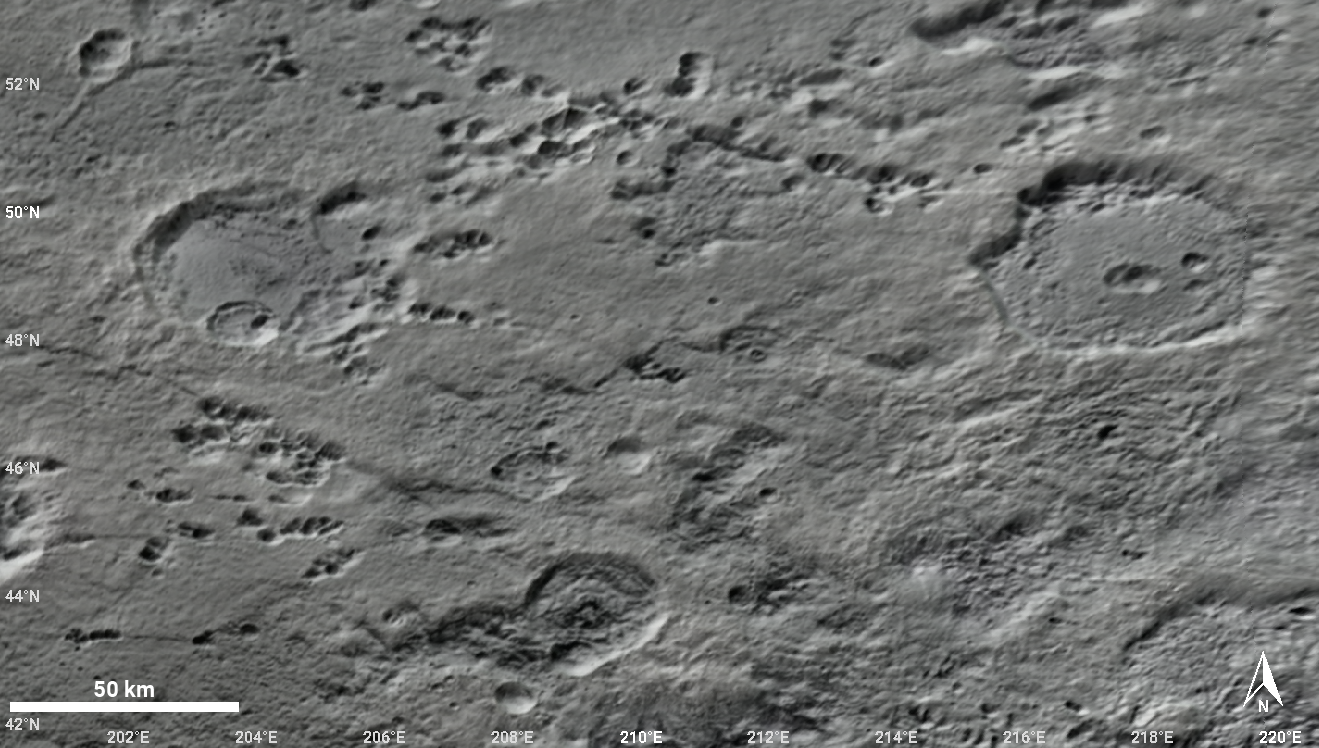
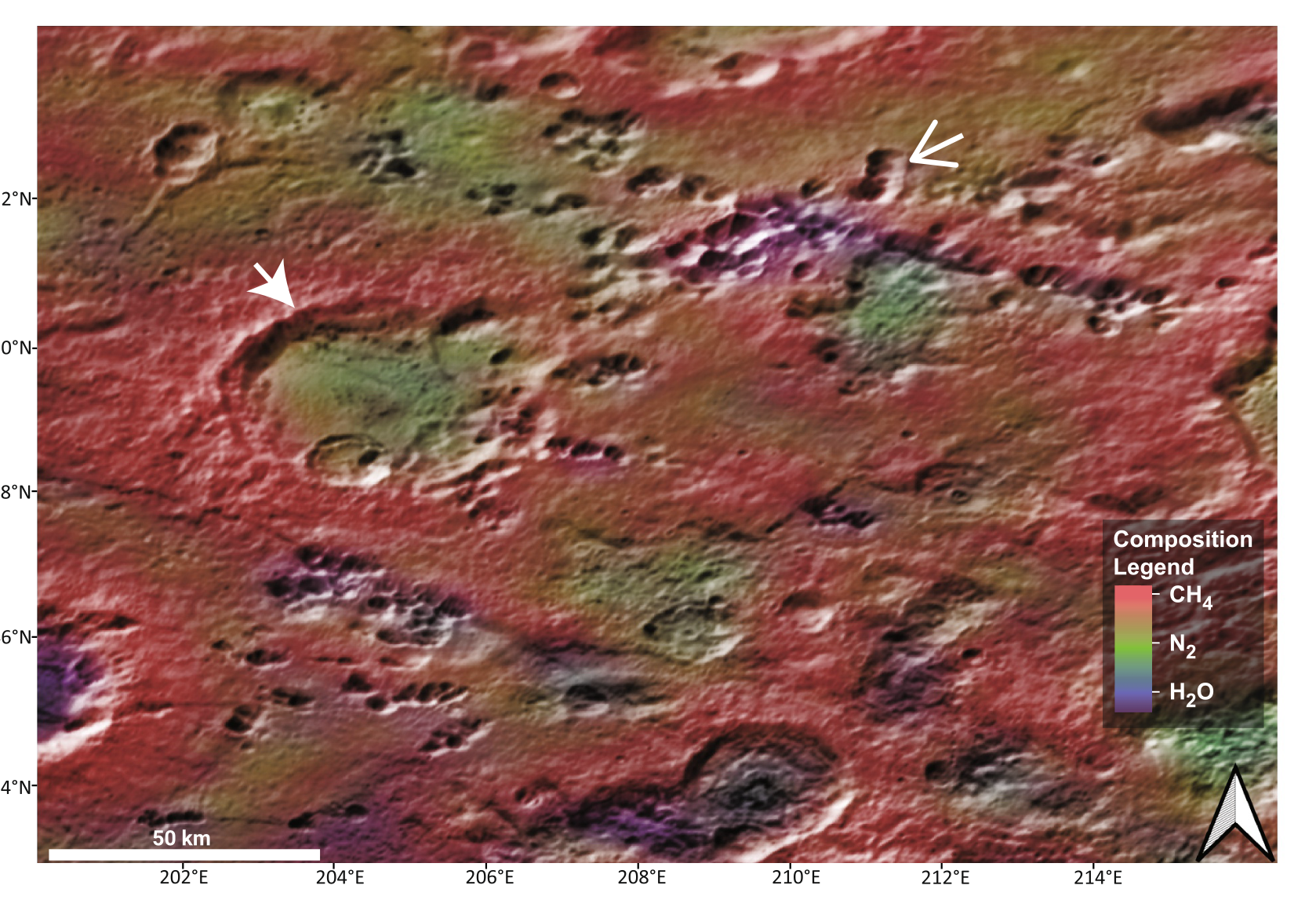
Top: An image shows the studied pit complex and surrounding features on Pluto. Above: Surface composition of the study area based on LEISA imaging spectrometer.
– Manogaran and colleagues, LSU
When Manogaran first observed the clustering pits in the region she studies on Pluto, her gut reaction was that these could be sources of gas escaping from the dwarf planet’s subsurface.
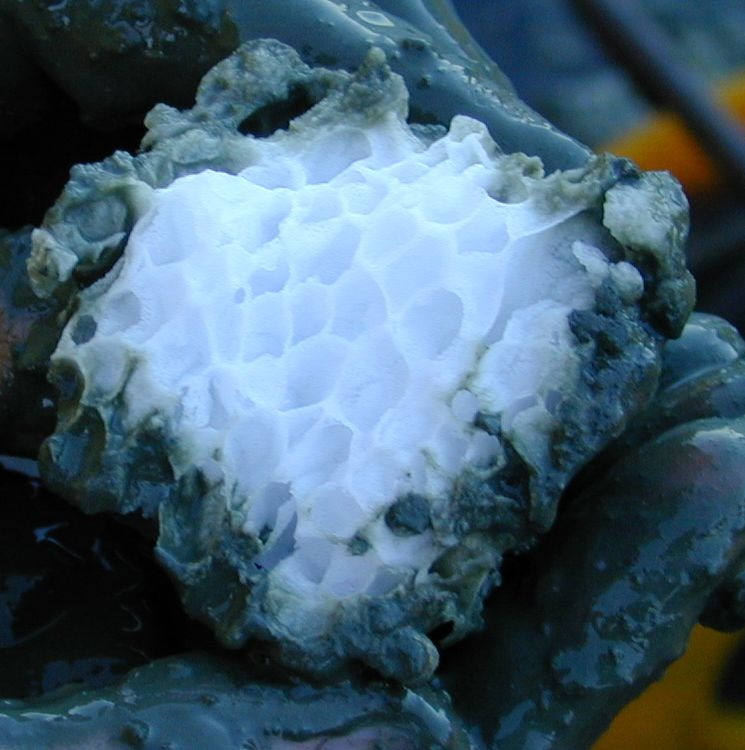
Structure of a gas hydrate (methane clathrate) block embedded in the sediment of hydrate ridge, off Oregon.
– Wusel007
After conducting research built on her background in petroleum geoscience, she found that very similar gas pockmarks occur on Earth in places where methane accumulates underground, trapped inside “cages” of frozen, crystallized water molecules called clathrate hydrates. When the gas eventually escapes and moves to the surface, often on the seafloor, it forms pits that look a lot like Pluto’s clustered pits.
After analyzing the geomorphology of 150 clustering pits on Pluto in a region called Pioneer Terra, Manogaran became increasingly convinced that she was seeing evidence of gas migration and seepage from the subsurface, possibly originating from gas hydrates as seen on Earth. This would explain both the appearance of these pits and how Pluto is replenishing its atmospheric constituents.
“Our findings imply the presence of volatile reservoirs in Pluto's subsurface that may periodically release gases that affect local landscapes and contribute to the atmosphere,” Manogaran said. “These findings could have important implications for the understanding of material exchange between the subsurface, surface, and atmosphere of icy worlds throughout the solar system.”
While more research is needed to confirm whether these pits are truly a source of gas such as methane on Pluto, Manogaran's findings are a vital clue to direct future efforts.

Roodra Manogaran with Drs. Gang Kai Poh and Kathy Mandt at NASA Goddard.
Read the paper: Geomorphological Evidence of Fluid Seepage in Pit Complex Formation, Pioneer Terra, Pluto
Next Step
Discover stories showcasing LSU’s academic excellence, innovation, culture, and impact across Louisiana.