


‘You’ll regret not trying’: LSU Geology Student Takes Non-traditional Route to Find New Purpose
April 13, 2026
Before studying ancient environments under a microscope, LSU undergraduate Tristan Ilgenfritz was working behind a salon chair. Ilgenfritz spent almost four years cutting and styling hair, and while he loved his job and used it as a creative outlet, he wanted more out of life.
“I never really felt fully fulfilled,” he said. “I felt like I wasn’t living up to my fullest potential.”
The decision wasn’t instant, but one experience helped clarify everything. It wasn’t until he visited Yellowstone National Park that he realized he wasn’t just looking at nature; he was trying to understand it. Even before returning to school, he found himself discussing topics like hiking and earth science with clients while working in the salon. He realized the vision had always been there; he just had to take the leap.
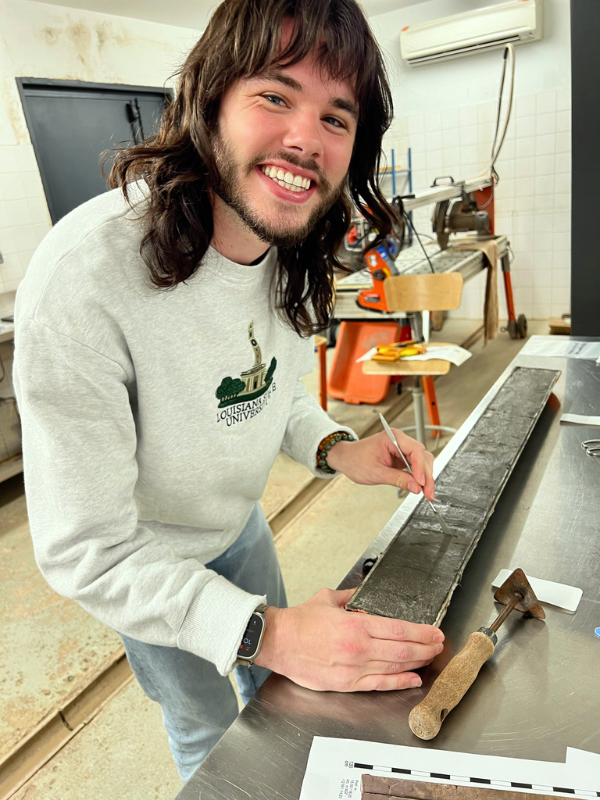
Ilgenfritz analyzes samples during research.
At first, being 26 years old and not on the traditional undergraduate route, he was intimidated and filled with self-doubt, worrying he might not be smart enough to follow his dreams. While he said the transition to a STEM education was quite difficult, the real-world experience he had already obtained in his years as a hairstylist helped him succeed. Balancing a job while pursuing his education, he had already built the discipline to show up and hold himself accountable, habits he’d been practicing for years.
Today, Ilgenfritz is immersed in research through LSU’s Center for Excellence in Palynology (CENEX), working under geology professor Sophie Warny. His work focuses on palynology, the study of microscopic organic materials like pollen and spores that are preserved in sediments. Though nearly invisible to the naked eye, these particles hold powerful insights into Earth’s history.
“It’s looking at really small things that tell a much bigger story,” Ilgenfritz explained.
His research focuses on reconstructing environmental conditions from millions of years ago. His REU (Research Experience for Undergraduate) project examines the Messinian Salinity Crisis, a geological event when the Mediterranean Sea partially dried up, leaving behind massive salt deposits.
“I’m looking at whether environmental factors, like fire activity, played a role in why that happened,” he said.
Once this NSF-funded REU is completed this summer, Ilgenfritz will turn his focus on pursuing an undergraduate thesis in the Fall. For this project, he will be expanding into geoarchaeology. Through a research partnership in Fréjus, France, he will be studying sediment samples to track changes in sea level over time and identify evidence of ancient human activity. He already had the opportunity to travel to Fréjus to participate in the sampling expedition.
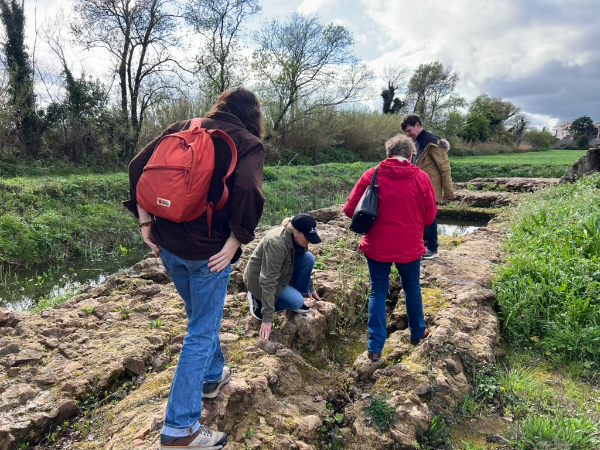
Ilgenfritz studies rock formations in the field.
“We’re looking for things like olive and grape pollen to see if there were Roman cultivations in the area,” he said.
His day-to-day life is quite different from what salon life looked like. He spends most of his days in a lab analyzing samples under a microscope, listening to music, and sipping on his espresso. He said while this might seem peaceful or even anticlimactic, interpreting microscopic structure requires a lot of patience because it is complex and time-consuming.
“You have to learn taxonomy (the classification of organisms), and the samples don’t always look the same depending on how they’re preserved,” he said. “It takes a lot of time and focus.”
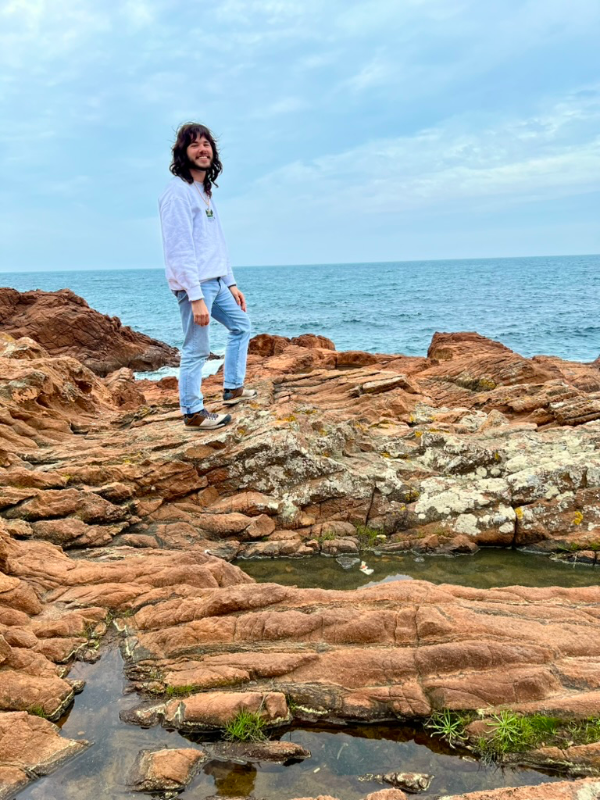
Tristan Ilgenfritz explores a rocky coastline.
Working with Warny has also shaped his experience. He said her high expectations and mentorship have pushed him to grow, helping him develop confidence in both his abilities and his place in the field. The opportunity to participate in global research as an undergraduate has been transformative. It has allowed him to connect with researchers beyond LSU, opening doors he never imagined when he first returned to school.
“ You can’t let fear hold you back. You’ll regret not trying. ”
Looking ahead, Ilgenfritz plans to pursue a master’s degree and continue working in environmental reconstruction or geoarchaeology. Beyond research, he hopes to share his work with a wider audience, making science more accessible and engaging for the public and not just academia.
His journey, from hairstyling to geology, serves as a reminder that it’s never too late to change direction. What began as uncertainty has turned into purpose, driven by curiosity, and the willingness to take a chance.