


LSU Research Bites: Stronger Concrete From Plant Waste May Advance More Sustainable Construction Practices
May 07, 2026
The cells of plants, unlike those of humans, have a tough “wall” that surrounds each of them. This is composed of structural components that enable plants to grow upright without a skeleton and create materials like wood. One of the materials in plant cell walls is cellulose.


Given the amount of agricultural waste produced by crops such as sugarcane and rice in Louisiana, experts have explored a range of ways to put the leftover plant cell wall material to use.
At LSU, researchers are studying how cellulose can be formed into tiny yet very strong crystals that can be used as reinforcing fillers in materials like concrete, among other applications.
Why Add Nanocellulose to Concrete?
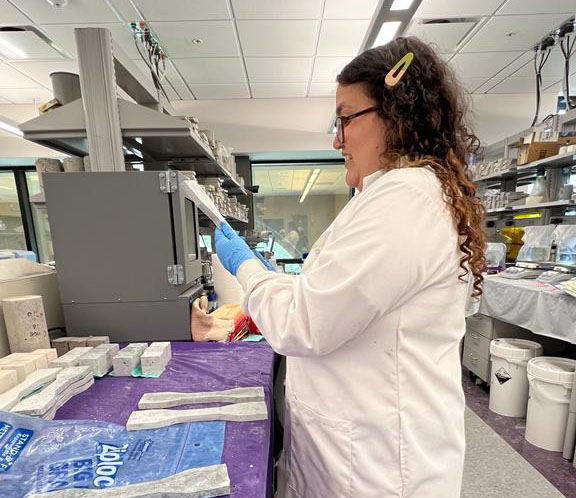
Andrea Gavilanes
“Nanocellulose has been widely studied as a reinforcement for concrete due to its ability to enhance mechanical performance,” said Andrea Gavilanes, doctoral student in the LSU College of Engineering. “Beyond optimizing nanomaterial concentrations to enhance mechanical performance, our work seeks to uncover the fundamental mechanisms responsible for these improvements.”
Working in Marwa Hassan’s lab, Gavilanes leads efforts to test the incorporation of nanocellulose into a wide range of materials, from conventional concrete to advanced bendable concrete.
“But less attention has been given to its sustainability impacts,” she said.
Gavilanes and colleagues recently published a study investigating the incorporation of cellulose nanocrystals derived from rice husks, an agricultural byproduct, into concrete, to enhance its performance and sustainability. Gavilanes and a graduate student from The Hong Kong University of Science and Technology collaborated closely to conduct a life cycle assessment of nanocellulose-reinforced concrete. The nanocellulose added to the concrete was synthesized in Hassan’s lab at LSU.
Environmental Trade-Offs of Stronger Concrete
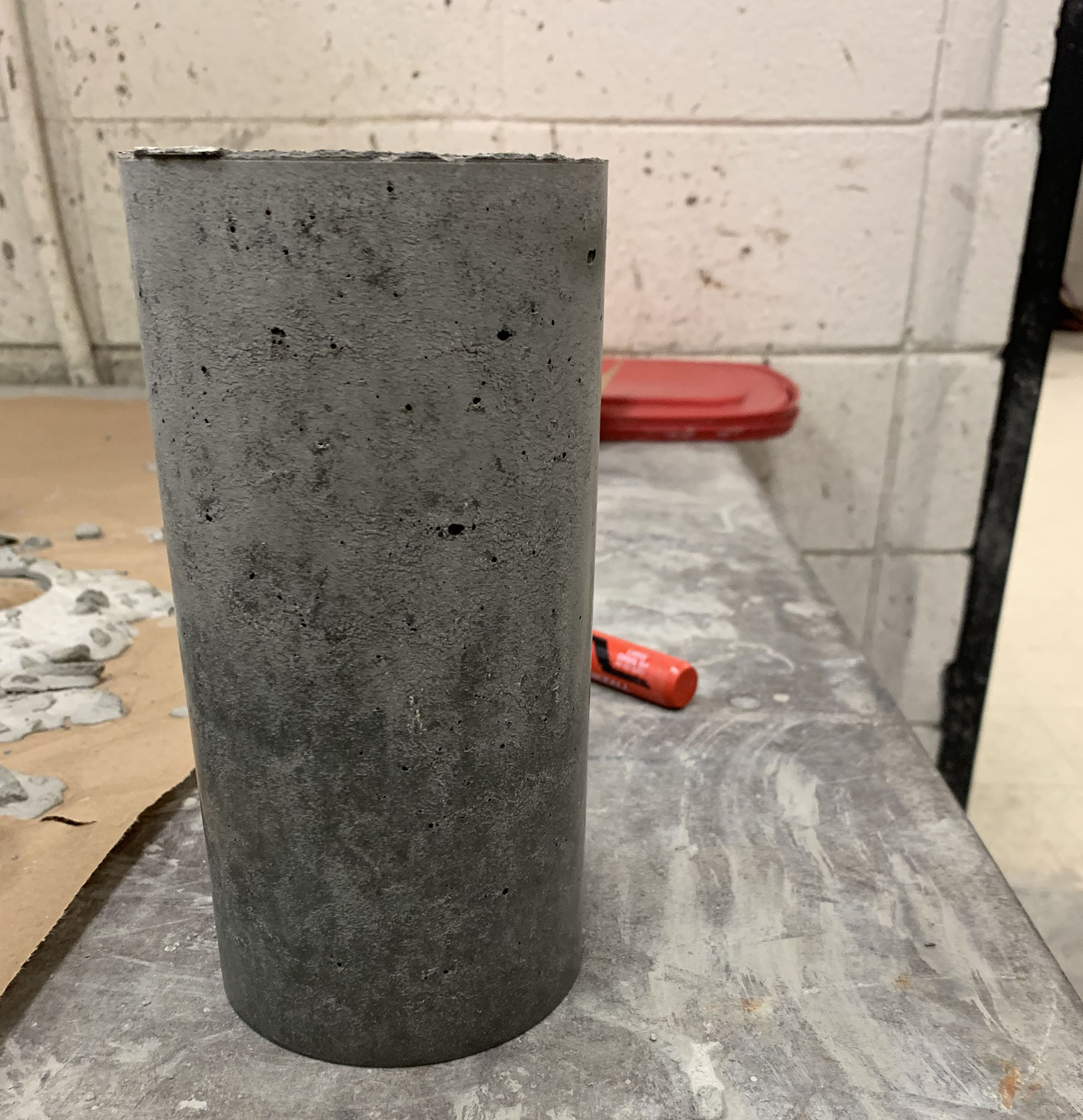
Concrete sample reinforced with nanocellulose.
The study revealed a trade-off between improved compressive strength of nanocellulose-reinforced concrete and its associated environmental impacts. Unfortunately, nanocellulose is often produced using a chemical process that Gavilanes and colleagues found harms the ozone layer. This vital region of Earth's stratosphere absorbs most of the sun's harmful ultraviolet radiation.
But Gavilanes sees this as more of an opportunity than a challenge. She hopes these findings will inspire researchers to explore alternative methods for synthesizing nanomaterials to enhance the performance of construction materials while reducing their environmental footprint. For example, she has proposed that the method could use a mild bleaching treatment instead of a strong one, and reuse chemicals involved in hydrolysis.
Read the study: Nanocellulose Integration in Concrete for Enhanced Performance and Sustainability