
As NASA’s Roman Space Telescope Prepares for Launch, LSU Scientists Are Ready for Discovery
August 27, 2026
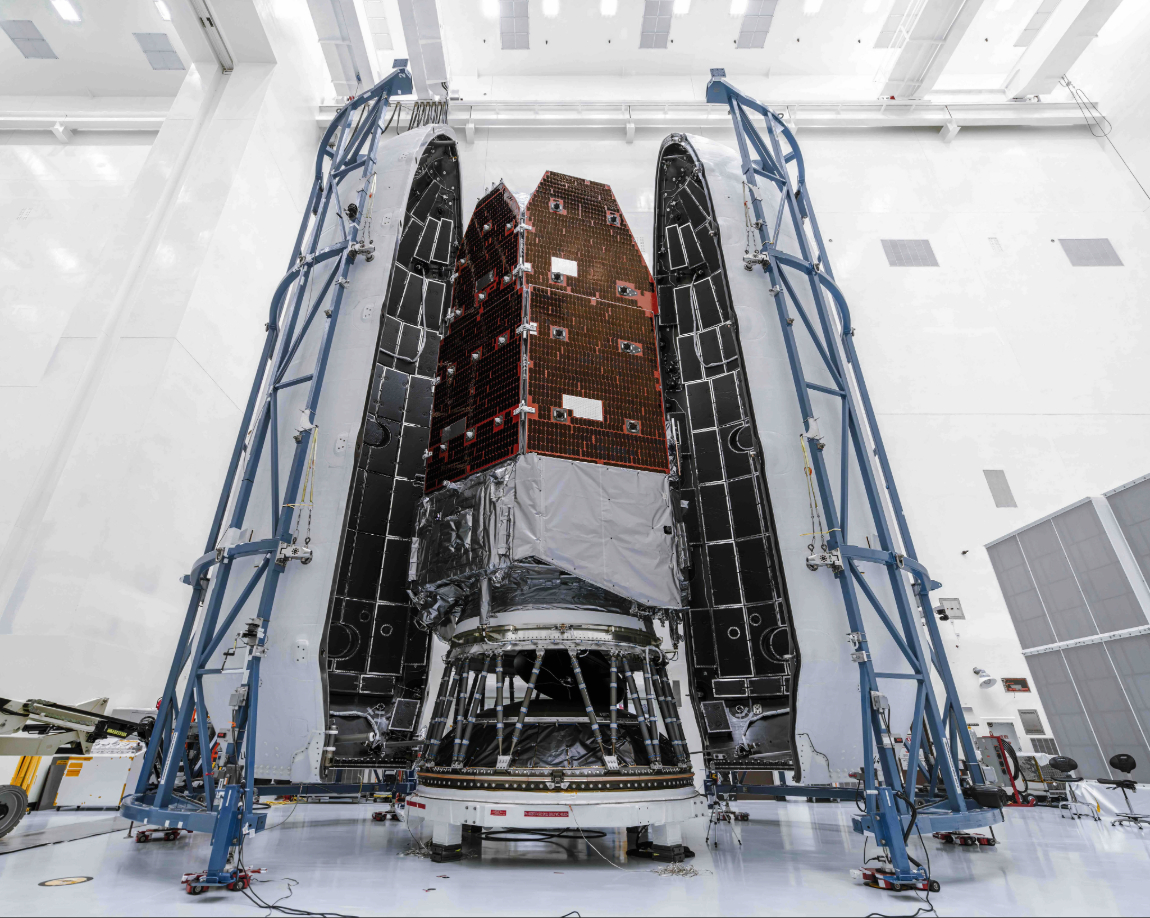
NASA’s Nancy Grace Roman Space Telescope is encapsulated within its payload fairing at Kennedy Space Center ahead of launch aboard a SpaceX Falcon Heavy rocket. The fairing will protect Roman during rollout and ascent. Once in space, Roman will study dark energy, dark matter, planetary systems, and a broad range of astrophysical phenomena.
– Credit: NASA/Sydney Rohde (Rocz)
When NASA’s Nancy Grace Roman Space Telescope launches Aug. 30, LSU astronomer Matthew Penny will see more than a decade of preparation finally make its way into space.
Penny’s involvement with the mission dates back to 2012, when he began developing simulations that helped shape its science requirements and influenced the spacecraft’s design. He later helped define a major survey that Roman will conduct.
Now, after years spent predicting what Roman might see, Penny is preparing to find out what is actually out there.
“As we approach launch, the priorities of my group are changing,” Penny said. “Simulations will continue to be useful for interpreting the data from Roman, but most of our effort will go into making new discoveries with the data Roman gathers.”
Hubble’s Sharp Vision on a Much Bigger Scale
Roman’s primary camera, the 300-megapixel Wide Field Instrument, will produce images with the same angular resolution as the Hubble Space Telescope, but with a field of view at least 100 times larger. Each image will capture a patch of sky larger than the full moon's apparent size, allowing Roman to gather data up to 1,000 times faster than Hubble.
In its first five years, Roman is expected to image more than 50 times as much sky as Hubble covered in 30 years, completing surveys that would take Hubble hundreds or even thousands of years.
Roman will also operate in a very different neighborhood. While Hubble orbits Earth at roughly 300 miles above the planet, Roman will travel about 1 million miles away to the second Sun-Earth Lagrange point, or L2, the same region of space used by the James Webb Space Telescope.
At L2, the gravity of the Sun and Earth, combined with Roman’s motion around the Sun, will allow it to maintain a relatively steady orbit and a constant, largely unobstructed view of the sky. Its distance also reduces the effects of heat from Earth, the Sun and the Moon — an advantage for an observatory designed to see in infrared light.
From there, Roman will investigate some of astronomy’s biggest questions, including dark matter, dark energy, and planets beyond our solar system. Much of Penny’s work focuses on one of Roman’s core surveys, which will observe the center of the Milky Way.
Watching Millions of Stars to Find New Worlds
Roman’s Galactic Bulge Time-Domain Survey, or GBTDS, will repeatedly turn its attention to the Milky Way’s central region. The survey will cover roughly 1.7 square degrees containing more than 200 million stars, imaging the same region at Hubble-like resolution every 12 minutes for six continuous stretches of 72 days spread across five years.
Since joining LSU in 2019, Penny and his group have continued developing simulations for the GBTDS, modeling the stars Roman will see and the observations the telescope will collect. Penny also served on the GBTDS Core Community Definition Committee, helping shape the final survey to detect large numbers of small, cold planets while maximizing its broader scientific return.
His group’s simulations helped determine where Roman should look, how much sky the survey should cover, how frequently it should observe, and which filters it should use.
A major goal is finding planets through gravitational microlensing.
Microlensing occurs when a massive object — such as a star, planet, or black hole — passes almost directly between Earth and a more distant star. The gravity of the foreground object bends the light from the background star around it, causing the light to travel along multiple paths toward us and creating separate images of the star. Those images are usually so close together that even space telescopes cannot distinguish them. Instead, they appear as a single, magnified source, making the background star temporarily look brighter. If the foreground object is a star with a planet, the planet’s gravity can create an additional change in that brightness, revealing its presence.
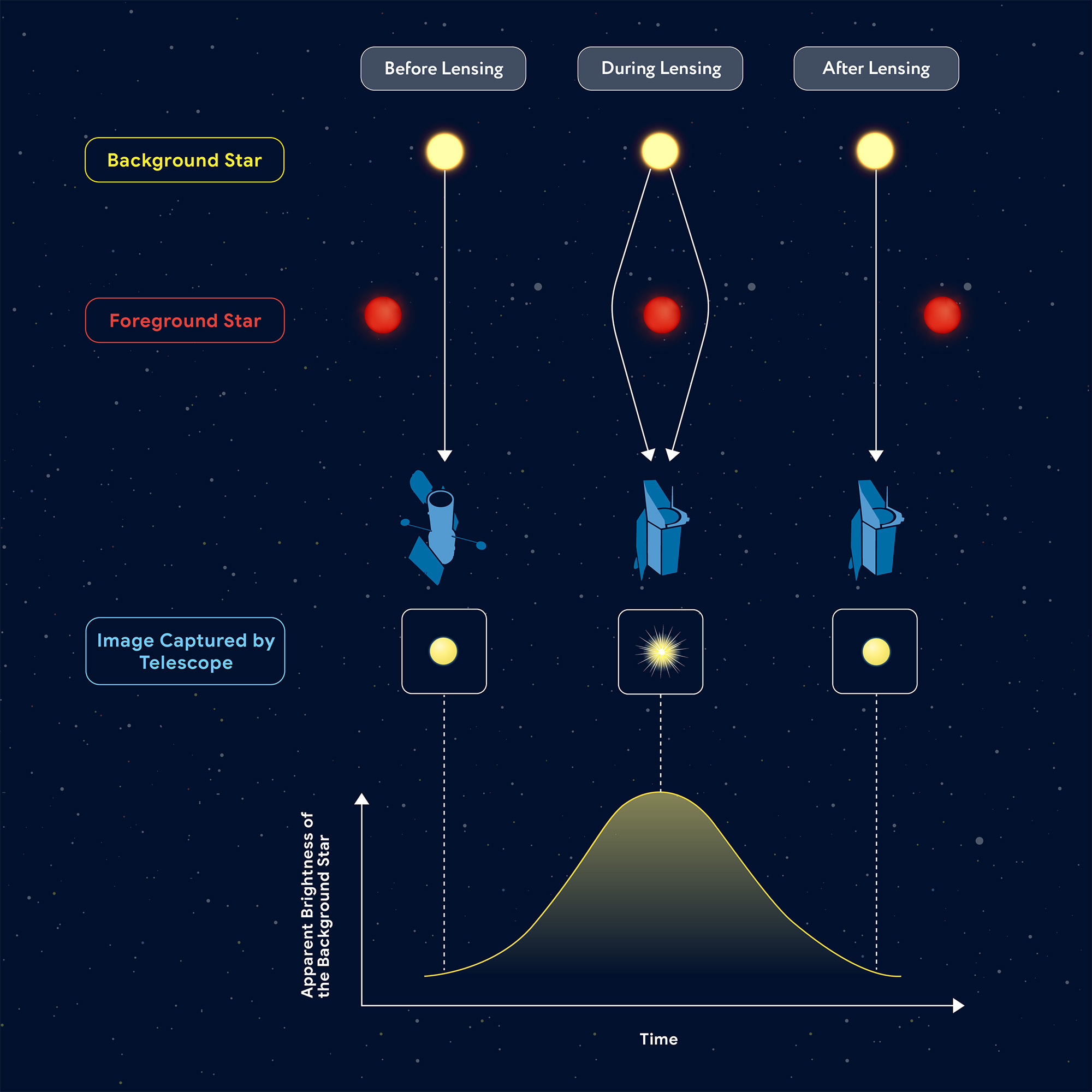
Roman will be especially powerful for studying gravitational microlensing, which occurs when a foreground object, such as a star or black hole, passes in front of a more distant star. The foreground object’s gravity bends and magnifies the background star’s light, causing it to temporarily appear brighter. The graph shows how that apparent brightness changes as the objects move into and out of alignment, creating a signal astronomers can use to detect planets, stars, black holes and other objects that may otherwise be difficult to observe.
– Credit: NASA, STScI, Joyce Kang (STScI)
The effect is both rare and fleeting. For any individual star near the center of the Milky Way, the necessary alignment occurs roughly once every 100,000 years, and a planetary signal may last only hours or days. Roman overcomes those odds by repeatedly watching an enormous number of stars. The survey is expected to reveal more than 1,000 cold exoplanets through microlensing, along with hundreds of free-floating planets.
Penny’s simulations suggest that during those observations, new planets could appear at a rate of a few per day, including potentially complex systems such as circumbinary planets orbiting two stars, planets with moons, or systems containing multiple planets.
But Roman will find much more than planets. Penny describes the GBTDS and Roman’s other surveys as a “treasure trove for stellar astrophysics,” containing millions of variable stars, hundreds of black holes, and around 100,000 transiting planets — planets that cause a dip in the brightness of their host stars when they pass in front.
Ready for Roman’s First Data
LSU researchers are already positioned to take advantage of Roman’s first observations. In the mission’s first call for research proposals, four of five LSU-led proposals were selected for funding, bringing in about $900,000 for Roman-related research. The awards support work by Penny, faculty members Tabetha Boyajian and Robert Hynes, and postdoctoral researcher Himanshu Verma. Their projects span stars, planets, and black holes, reflecting the range of science Roman will make possible. Graduating LSU student Ashley Elliott also received a NASA Postdoctoral Fellowship to work with Roman data.
Penny’s newly funded project will combine observations from the European Space Agency’s Euclid space telescope with Roman data to measure how stars are moving in the GBTDS fields.
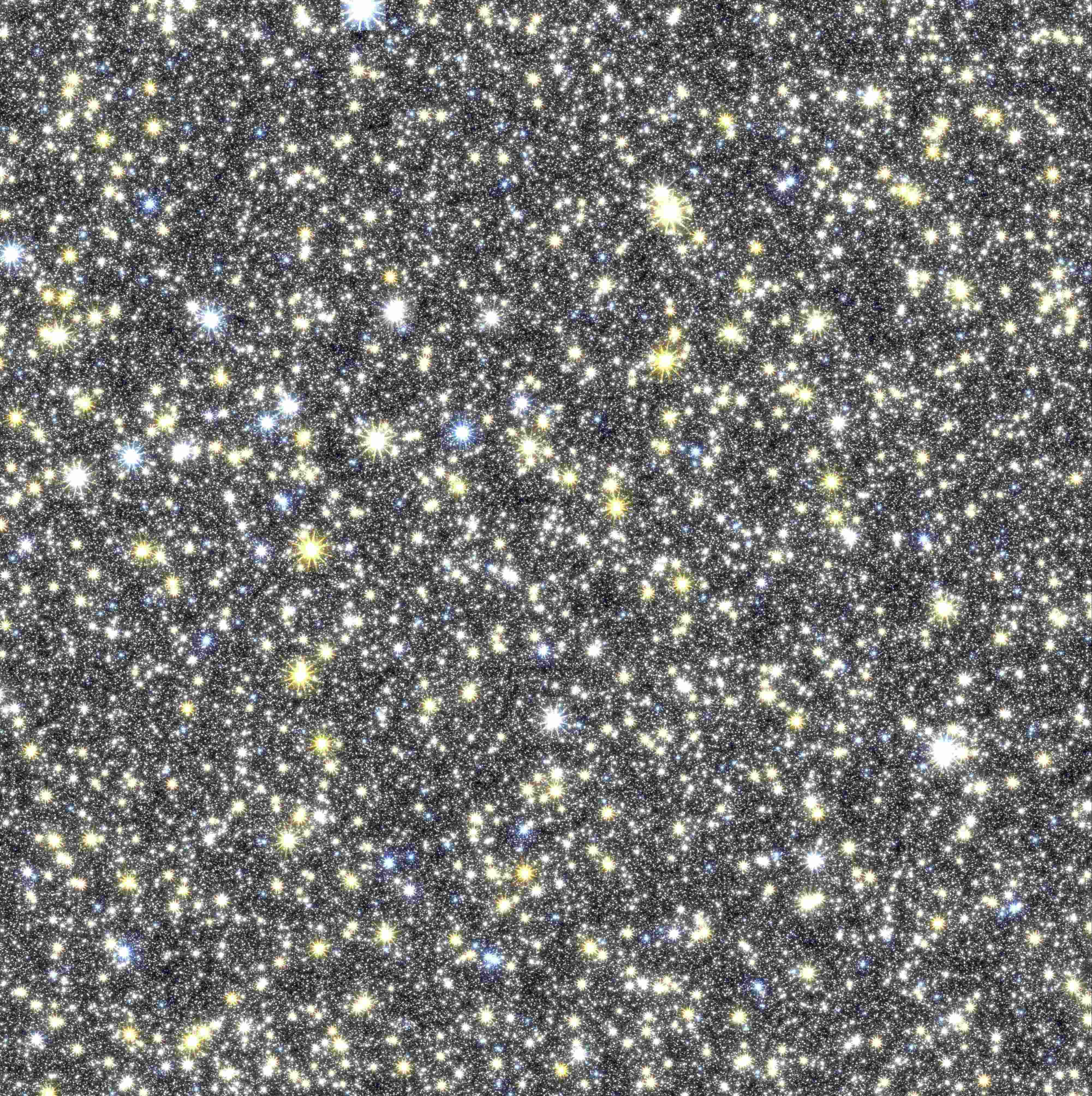
A simulated view of approximately 1% of Roman’s survey area. After years of developing simulations for the mission, LSU astronomer Matthew Penny is now preparing to analyze Roman’s actual observations.
Verma’s project will take a closer look at rare microlensing events. Normally, the multiple images created when a foreground object bends the light of a background star are too close together to distinguish. Verma will search for cases where Roman can actually resolve those separate images. For the two images to be far enough apart for Roman to distinguish, the lens will likely need to be a black hole or an object relatively close to Earth.
Black holes are also part of Hynes’ Roman research, but from a different perspective. Hynes, professor of physics and astronomy, and his collaborators will search for black holes and neutron stars quietly hiding in binary systems near the center of the Milky Way. NASA’s Chandra X-ray Observatory has already cataloged thousands of faint X-ray sources there, many of which could be black hole or neutron star binaries, but most remain unclassified. Roman’s repeated observations could reveal periodic brightening caused by a star being gravitationally distorted by an unseen companion, as well as flickering that signals active accretion.
Because it operates from space in infrared light, Roman will be much less affected by interstellar dust and stellar crowding in the Galactic bulge than previous ground-based optical studies. Hynes’ project aims to finally pin down how many black holes and neutron stars are quietly lurking in binary systems throughout the bulge, offering a new window into how these extreme objects form and evolve.
Understanding what Roman finds will also depend on understanding the stars themselves — and that creates a connection between one of NASA’s newest observatories and an astronomical legacy that began at LSU decades ago.
Associate Professor Tabetha Boyajian will use stars from the standard-star network established by the late LSU Professor Arlo Landolt to improve the relationship between a star’s color and its apparent size. These “color-surface brightness” relations will help astronomers interpret microlensing events and determine the properties of the planets Roman discovers.
“I’m especially excited that this project connects Landolt’s remarkable legacy at LSU with one of NASA’s next great observatories,” Boyajian said. “As we get closer to launch, it is exciting to think that measurements of stars he began making decades ago will help us characterize entirely new worlds discovered by Roman.”
That work extends to the next generation of researchers as well. Graduating student Ashley Elliott is involved in the Roman All-Star catalog, an effort to provide stellar parameters for roughly 100 million stars observed by the GBTDS, and will continue working with Roman data through a NASA Postdoctoral Fellowship.
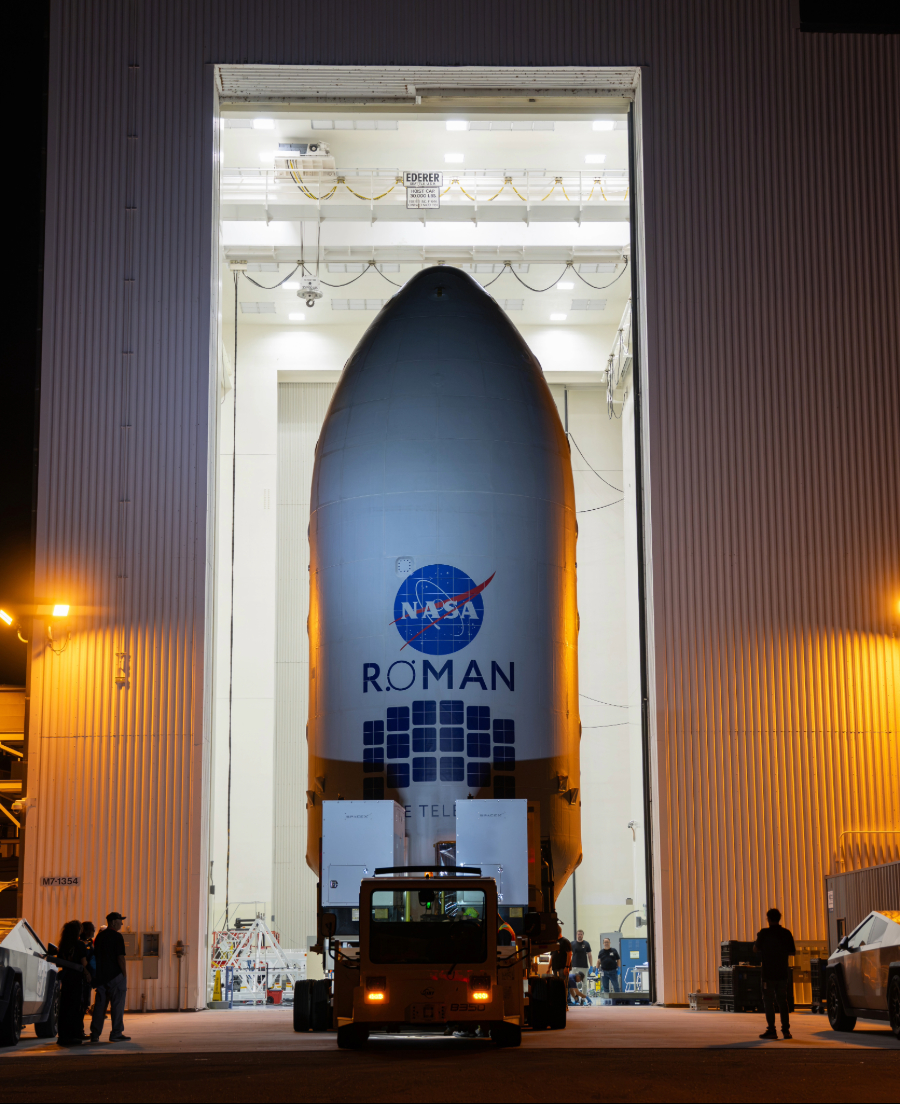
NASA’s Nancy Grace Roman Space Telescope, enclosed within its payload fairing, is transported at Kennedy Space Center ahead of launch.
– Credit: NASA/Sydney Rohde (Rocz)
“Without proper stellar characterization of the host stars, any study of the planets will not be as meaningful,” Elliott said.
“I personally am excited to see how Roman will change the exoplanet field as we know it today and to see all of the brand new worlds that are out there,” she said.
Watch the Launch
NASA and SpaceX are targeting the Nancy Grace Roman Space Telescope for launch no earlier than 7:26 a.m. EDT Sunday, Aug. 30, aboard a SpaceX Falcon Heavy rocket from Launch Complex 39A at NASA’s Kennedy Space Center in Florida.
NASA’s live launch coverage begins at 6:20 a.m. EDT and will be available through NASA’s streaming platforms.