
Chasing down a dream
August 24, 2026
Four veterinary students share the grit, grace, and glory involved in pursuing their goals
This is the fourth and final installment in a series of four veterinary students sharing what it takes to become a veterinarian.
Kristi Haakma, Year 4
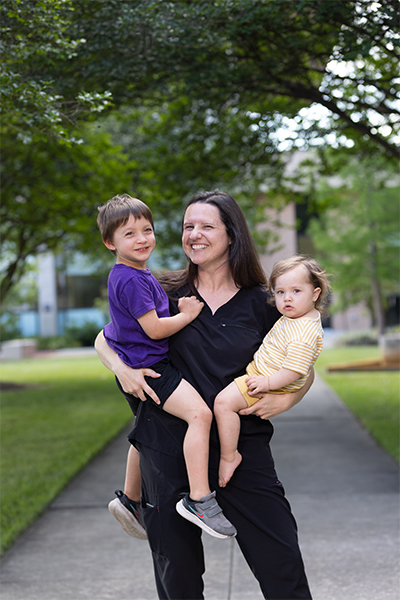
Veterinary student Kristi Haakma with her two children.
Kristi came to LSU Vet Med knowing what she wanted to do in her second career: veterinary oncology. After six years as an elementary school teacher in Iowa and California, she made a life-changing decision to pursue her passion for animals. None of her previous degrees—a B.S. in elementary education and an M.Ed. in early childhood education—counted toward veterinary school prerequisites. Still, she completed the required coursework during the COVID-19 shutdown and applied to 10 veterinary schools before choosing LSU Vet Med.
When Kristi began in 2022, she was 29 years old—and the only student in her class with a child. Her son, Coen, was just one year old. “I felt lonely at times. Everyone else went home and decompress or study. I’d go home and turn on my mom role,” she said. “I would begin studying at 10 p.m. and continue as long as I could stay up.”
She brought her toddler to class on a few occasions when her wife was sick or had appointments. “He sat in the back row with me, and my classmates saw the reality of me being a mom,” she said. “Some professors even held him while lecturing. He has grown up here, and now his sister, Cali, who’s a year old, has too. This community has really embraced me and my family.”
Academically, the adjustment was just as challenging. In her first course—an accelerated, two-week cell biology class—she earned a D. “I cried and asked the dean of student success if I should even be here,” she said. The answer she received: keep going. Kristi adapted, learning to study more efficiently and work through setbacks.
Her perseverance paid off in the clinic. In one satisfying case, she created a radiation treatment plan for a dog, mapping out tumor location and beam placement. “I was able to see that dog go through radiation therapy and graduate from treatment three weeks later,” she said.
Kristi remains grounded in her goal: veterinary oncology. Her passion stems from a personal experience—her own dog was diagnosed with nasal adenocarcinoma, and her veterinarian’s compassion left a lasting impression. For the past four years, Kristi has shadowed radiation oncologist Dr. Jayme Looper and even conducted strontium-90 radiotherapy research with her. They are aiming to publish their work next year.
“I have learned that I am more capable than I think I am, and connecting with people has always been a strength. In oncology, it’s important to be able to walk with clients through every step,” she said.
Now, as she looks ahead to her internship, Kristi is eager to put what she has learned into practice and continue doing what drew her here in the first place: helping animals who cannot speak for themselves to heal.