
Learning Beyond the Classroom: How HNRS 3025 Connects Students to Louisiana’s Rural Communities
April 06, 2026
What does it mean to truly understand a community? For students in Alvera McMillan's section of HNRS 3025, the answer lies in the landscapes, cultures, and relationships that shape rural Louisiana.
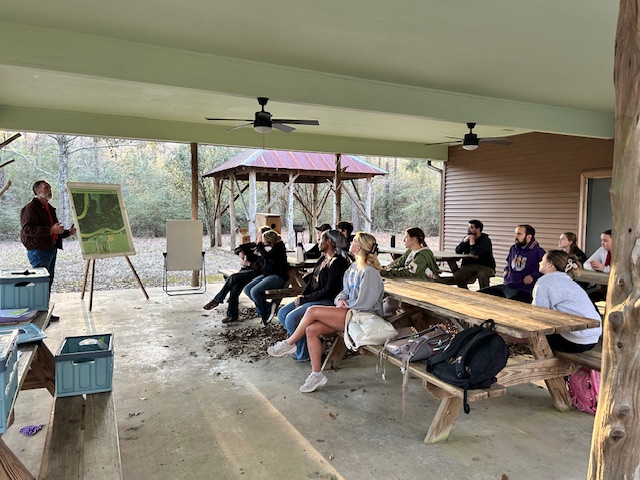 LSU Honors students learning on-site at Mary Ann Brown Nature Preserve. Photo credit:
Alvera McMillan
LSU Honors students learning on-site at Mary Ann Brown Nature Preserve. Photo credit:
Alvera McMillan
This spring, students in the Ogden Honors College had a chance to enroll in a section of HNRS 3025 titled Rural Communities, Cultures, and Cross-Disciplinary Literacies. Taught by Education Specialist for the Louisiana Sea Grant College Program Dr. Alvera H. McMillan, the course challenges students to move beyond traditional academic boundaries and engage with communities as dynamic, interconnected systems.
“Students are learning to examine rural communities as complex systems where culture, ecology, and social relationships intersect,” McMillan said.
This interdisciplinary approach, what McMillan describes as “cross-disciplinary literacies,” blends research, communication, and lived experience. Students learn with and from local rural communities through a nature place-based learning model that emphasizes connection, collaboration, and reflection.
Learning Through Experience
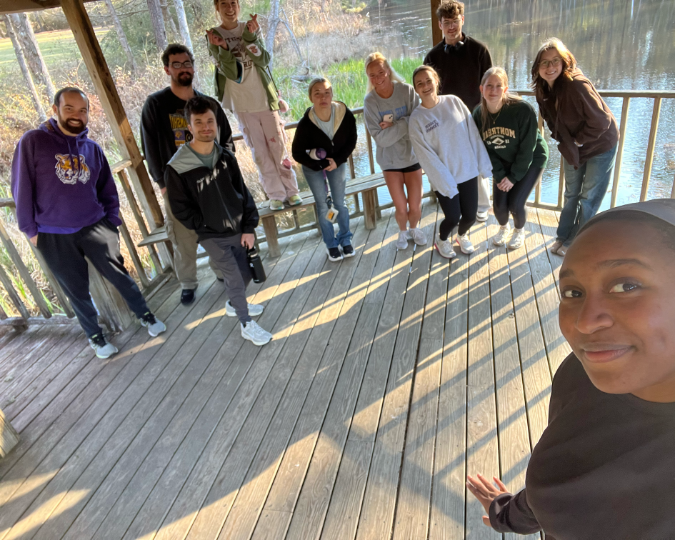 Throughout the semester, students participate in field experiences that bring course
concepts to life. Early on, they traveled to the Mary Ann Brown Nature Preserve in
St. Francisville, where they explored Louisiana’s unique ecosystems and considered
how natural environments shape community life.
Throughout the semester, students participate in field experiences that bring course
concepts to life. Early on, they traveled to the Mary Ann Brown Nature Preserve in
St. Francisville, where they explored Louisiana’s unique ecosystems and considered
how natural environments shape community life.
Later, they applied those insights through a service-learning partnership with Livonia High School. There, Honors students collaborated with members of the school’s Outdoor Club, leading hands-on activities, including a waterflow simulation of the Mississippi River and Atchafalaya watersheds, that connect environmental science with real-world impact.
“Understanding communities requires more than reading about them—it requires connection and experiences within them,” McMillan said. “Through field experiences and service-learning, students observe local ecosystems, engage with community members authentically, and reflect on how environmental and social systems are interconnected.”
These experiences deepen students’ understanding of rural places and challenge them to step outside their comfort zones and communicate across different audiences.
Building Skills That Matter
Designated as both a communication-intensive and service-learning course, McMillan’s section of HNRS 3025 emphasizes practical skill-building alongside academic inquiry. Students develop written, oral, and analytical communication skills while working on real-world projects, including crafting media releases about their service-learning work to share with community partners and local media.
They also engage with frameworks like the Community Capital Framework, which helps them understand how different forms of capital (natural, cultural, social, and human) interact to shape a community’s resilience and growth.
By the end of the course, students are applying the information they have absorbed over the semester. Each student develops a service-learning proposal tied to a community they care about, connecting course concepts to their own lives and future goals.
Louisiana's Rural Communities
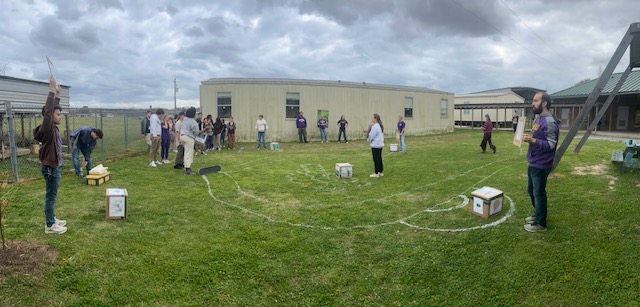 :LSU Honors students learning on-site at Livonia High School. Photo credit: Alvera
McMillan
:LSU Honors students learning on-site at Livonia High School. Photo credit: Alvera
McMillan
For McMillan, Louisiana provides an ideal setting for this kind of work.
“Louisiana offers an incredibly rich context for exploring how culture, ecosystems, and community life are deeply intertwined,” she said. “By working within these communities, students develop an understanding of how people and places interact—and a deeper respect for the knowledge and resilience that exist within rural communities.”
That perspective is central to the course’s mission. By engaging directly with rural communities, students begin to see the value of collaboration, civic engagement, and place-based knowledge as lived experiences instead of abstract ideas.
The OHC Difference
The structure of the Ogden Honors College plays a key role in making this kind of course possible. With a small, interdisciplinary group of students, HNRS 3025 creates space for meaningful discussion, collaboration, and intellectual risk-taking.
“The Honors College format allows the course to function across disciplines, bringing together students with different majors and diverse skill sets,” McMillan said. “Students are encouraged to be curious, engage in intellectual risk-taking, and collaborate across disciplines.”
That environment allows students to synthesize ideas from multiple fields while developing their own perspectives on community, culture, and engagement.
Looking Ahead
As the semester winds down, students are developing service-learning projects that extend beyond the classroom and into communities that matter to them.
For many, the course offers a new way of thinking about their role in the world.
“I hope students come away with a deeper respect for the knowledge, resilience, and
ingenuity that exist within rural communities,” McMillan said, “as well as a tangible
awareness of the potential within each one of them to make a positive difference.”