
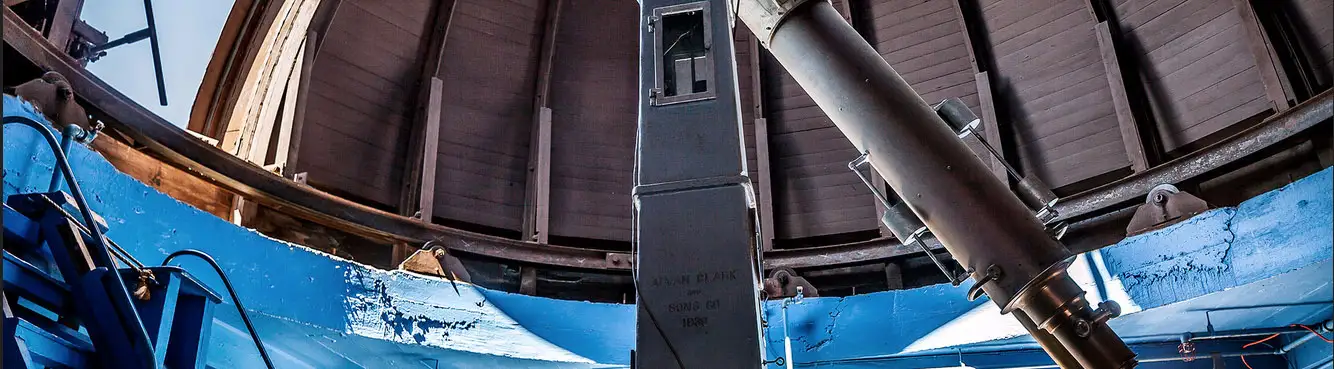
History of the Landolt Astronomical Observatory
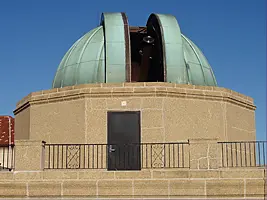
Landolt Astronomical Observatory Dome
The observatory on top of Nicholson Hall was first opened in 1939. The telescope is a refracting telescope with the lens having a diameter of 11.5-inches. The maker of the lens and the telescope was Alvan Clark & Sons. Clark was the premier maker of refracting telescopes and indeed is universally acknowledged to be the world's all-time best maker of refractor telescopes. LSU is lucky and proud to have such a classy instrument.
Long-focus refractors give a high-quality high-magnification view that is perfect for looking at the Moon and planets. Wonderful amounts of detail can be seen on the planets, including volcanoes, polar caps and morning-fogs on Mars as well as Jupiter's Great Red Spot and fine divisions in Saturn's rings. For the Moon, we can see large and small craters, huge impact basins and low volcanic domes. The views are wonderful and make one think of flying low over the surface of the Moon. The 11.5" Clark telescope is also good for looking at double stars and bright nebulae around the sky.
From the late 1940's to the 1970's, the telescope was used for taking many astronomical photographs for various purposes including scientific studies. However, for scientific purposes, the telescope can no longer compete, as its aperture is too small and the light pollution from the city makes for a very bright sky.
From 1939 to the early 1990's, the telescope was used for regular Public Nights as well as LSU classes of many types. Many people around Baton Rouge fondly remember coming out to see the wonderful sights with this excellent scope. The growing light pollution has little impact on visual views of the Moon and planets, as these are intrinsically bright targets.
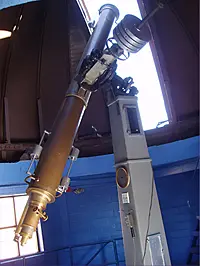
Landolt Astronomical Observatory Telescope
In the early 1990's, the observatory fell into disuse and some disrepair. The causes are just the normal ones that primary users retired and moved away, while its scientific utility was lost. From the mid-1990's until 2005, the observatory was essentially unused with the dome getting in poor shape. But the Clark telescope and lens do not 'decay', so in 2005 a group in the Physics and Astronomy Department worked long hours repairing and refurbishing the telescope. Most of this was in scraping and repainting everything, polishing the brass tube, replacing the doors and windows, and making a variety of repairs. The Clark lens was untouched. So finally, in early November 2005, the Department had a Grand Reopening with a Public Night at the time of Mars's closest approach. After almost two decades of inactivity, the Clark telescope is again showing beautiful views of the sky to students and Baton Rouge residents.
At the time of the Grand Reopening, it was realized that the observatory did not have a name. The obvious name for the observatory was to honor Professor Arlo U. Landolt (1935-2022) for long being the core of the astronomy program at LSU. With his long years of serving as the Secretary of the American Astronomical Society, Dr. Landolt is among the most recognizable of American astronomers. His long work at providing standard stars (used for calibrating photometry as is vital for ~10% of modern astronomy) is among the most-cited papers in all astronomy. Given his long and very strong contributions to LSU astronomy, American astronomy, and world astronomy; it is appropriate to dedicate the observatory as the "Landolt Astronomical Observatory" as a small recognition of his work.
In Commemoration of Professor Arlo Landolt
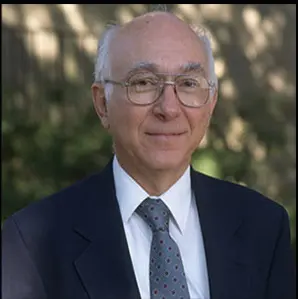
Arlo Landolt, Ball Family Professor Emeritus of Physics & Astronomy
The LSU community lost one of its internationally respected faculty members when Arlo Udell Landolt, Ball Family Professor Emeritus of Physics & Astronomy, passed away on Jan. 21, 2022. He was 86 years old.
Born Sept. 29, 1935, in rural southern Illinois, Landolt was one of the most recognizable of American astronomers. Renowned throughout the astronomical community for his discoveries, astronomers and physicists worldwide continue to use his series of papers which established the "Landolt Photometric Standard Star Catalog" and his standard stars are among the most heavily used photometric standards throughout the globe.
“Today we mourn the death and celebrate the remarkable life of Arlo Landolt, whose outstanding contributions as a researcher, teacher, mentor, and colleague set a standard that has inspired many of us,” said LSU College of Science Dean Cynthia Peterson, Seola Arnaud and Richard Vernon Edwards Jr. Professor. “Dr. Landolt was a true trailblazer in the scientific community, and the world will forever be changed by his work. We are deeply sorry to hear of his passing.”
Graduating with a Bachelor of Science degree from Miami University in Oxford, Ohio in 1955 as a double major in mathematics and physics, Landolt later received a doctoral degree in astronomy from Indiana University in 1963. While pursuing his PhD, he became a member of the first group to winter over at the International Geophysical Year's Amundsen-Scott South Pole Station in the Antarctic and served as the group's aurora and airglow scientist studying the Aurora Australis, or Southern Lights. John Irwin, his PhD thesis advisor at IU, interested him in binary stars, so he was able to secure time to observe the eclipsing binary V382 Cygni on KPNO in the summer of 1959.
Landolt was the first discoverer of a pulsating white dwarf when he observed in 1965 and 1966 that the luminosity of HL Tau 76 varied with a period of approximately 12.5 minutes.
He joined the faculty of the LSU Department of Physics & Astronomy in 1962 and was instrumental in the development of the astronomy group within the department to international status. He received more than $4.5 million in grants and published more than 100 peer-reviewed papers. In 2002, he was named LSU Ball Family Professor of Physics & Astronomy and in 2014 was inducted into the LSU College of Science Hall of Distinction. He has a number of sites named in his honor, including Mt. Landolt in the Antarctic, the LSU Landolt Astronomical Observatory in Nicholson Hall, and even an asteroid—15072 Landolt—is named after him.
“Arlo Landolt is one of the most dedicated scientists I've known, but his impact on the people around him was even greater than his many scientific achievements,” said Jeffery C. Blackmon, Russell B. Long Professor and Department Chair. “I became chair of the Department of Physics & Astronomy in July 2020. Arlo was one of the few people coming onto campus regularly then due to the pandemic. When he came to the office to get a cup of coffee, he would often stop by to bring me advice, words of encouragement, or some corny joke to lighten my day. I miss him very much.”
Landolt was elected a Legacy Fellow of the American Astronomical Society in 2020, was bestowed the 2015 Leslie C. Peltier Award from the Astronomical League, and received the George van Biesbroeck Prize from AAS in 1995, which honors a living individual for long-term extraordinary or unselfish service to astronomy, often beyond the requirements of his or her paid position.
Landolt’s research was concerned with the measurement of stellar brightness and colors, i.e., stellar photometry. In the last 30 years much of his time was spent in the improvement and the definition of photometric standard stars. These standard stars are used as calibration yardsticks when studying celestial objects, or indeed any objects projected against the celestial sphere, whose characteristics are unknown. For the case of physical celestial objects, one eventually can relate brightness and color measures to a variety of physical characteristics. These quantities in turn help determine stellar distance, define a star's place in stellar evolution, etc. Research projects also are under way in the areas of star clusters, variable stars, novae, supernovae, and eclipsing binaries.